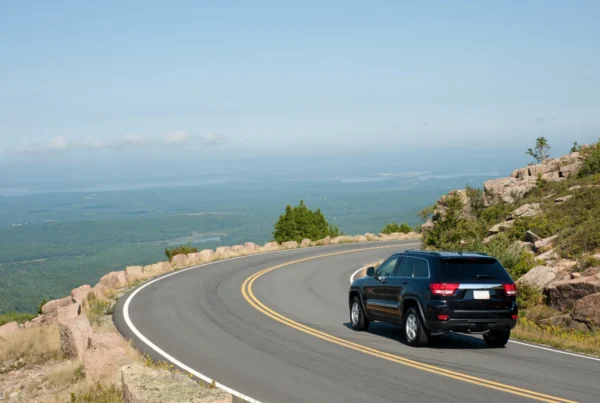

There is a particular Friday afternoon that repeats itself in Lee County. The cooler is packed, somebody is texting about parking, and the plan is to be north of the state line before dark. Nobody is thinking about tires, because the car ran fine all week.
Usually it is fine. But “running fine around Opelika” and “ready to spend four hours at seventy” are two different tests, and the second is harder. Around town a car never has to prove much: trips are short, speeds are low, brakes cool off at every light. Put that same vehicle on I-85 with four people and a full trunk and every marginal part gets a real question.
That is what a pre-trip inspection in Opelika, AL is for. We have been doing this at the counter since 1968, and here is the version we would give you standing right here in the shop: what changes on a long highway drive, what you can check in your own driveway the night before, what genuinely needs a lift, and how far ahead to book so we have time to order anything we find.
Why a Trip With a Date on It Changes the Math
Most car care is flexible. You notice something, you get to it next week, no harm done. A trip with a kickoff time attached takes that away. Three things change once you leave Opelika:
- Time under load. Highway speed is continuous work for the cooling system, belts, and tires. A weak hose will not embarrass itself on a five-mile commute. It will at hour three.
- Weight. A loaded vehicle stops longer and heats its brakes more than the empty version you drive to work.
- No easy off-ramp. A noise you would normally ignore becomes a decision made on a shoulder, in traffic, far from anyone you know.
The failures that actually ruin trips are boring, which is the good news. AAA answered nearly 600,000 emergency roadside calls over one recent Thanksgiving period, out of a projected 81.8 million people traveling at least fifty miles from home, and the leading causes were dead batteries, flat tires, and empty fuel tanks. Almost none of that is exotic, and almost all of it is checkable in advance.
The Trips Lee County Drivers Actually Take
This checklist is built around the drives that fill our Opelika bays every fall.
Auburn’s 2026 home schedule puts six Saturdays at Jordan-Hare Stadium, from Southern Miss on Sept. 12 through Samford on Nov. 21. The stadium seats 88,043, and more than 75,000 season tickets have sold in each of the last eighteen years. That is the traffic you sit in even when you stay home.
The away weekends are the real highway miles: Tennessee on Oct. 3, Georgia on Oct. 17, Ole Miss on Oct. 31, Mississippi State on Nov. 14, Alabama on Nov. 28, plus the opener against Baylor in Atlanta back on Sept. 5. I-85 runs eighty miles across Alabama, from Montgomery to the Georgia line near Lanett. Add Birmingham and the holiday drive to the coast and you have most of a Lee County driving year. A road trip car check in Opelika is built for those.
Tires: Pressure, Tread, and the Number Most Drivers Get Wrong
A highway trip is won or lost on the tires. Pressure first. The U.S. Tire Manufacturers Association recommends checking pressure at least once a month, and specifically before a long trip, a heavy load, or towing. Check the tires cold, parked at least three hours, and use the number on the door jamb sticker, not the one molded into the sidewall. Pressure also moves with the weather: inflation changes one to two pounds for every ten degrees of temperature change, so tires set on an August afternoon and driven in late November are not carrying what you think.
Now the number people get wrong. The replacement threshold is 2/32 of an inch of remaining tread. Michelin puts it the same way: when the tread wears level with the built-in wear indicators, at 2/32 inch, or 1.6 mm, the tire has reached minimum tread depth. The penny test checks the same thing. Put a penny upside down in a tread groove; if part of Lincoln’s head is covered you have tread left, and if you can see all of his head it is time for new tires.
Here is the part that matters on a wet interstate: that threshold is the scrap line, not the safe line. AAA’s all-season tire testing compared new tires against tires worn to 4/32 inch, where many drivers first start shopping. On wet pavement the worn tires stopped 42 percent longer for a Toyota Camry and 44 percent longer for a Ford F-150. Braking from 60 mph, the worn-tire vehicles were still moving at 39 mph and 37 mph where the new tires had already stopped. Cornering grip fell with it, down 33 percent for the Camry and 28 percent for the F-150.
Nobody plans on a wet interstate, but the odds are not small: the Federal Highway Administration counts roughly 745,000 weather-related crashes a year, more than 77 percent of them in rain or mist. A tire that passes the penny test is legal. Whether it is the tire you want on a rainy night on the I-85 corridor coming home from Athens is a different question. While the wheels are off, rotation gets handled too: USTMA suggests every 5,000 to 8,000 miles when your manual does not specify.
Tire Age Does Not Show in the Tread
Tread wear you can see. Age you cannot, and it runs on its own clock. Michelin recommends replacing tires ten years after the date of manufacture no matter how much tread is left, and having them inspected at least once a year by a trained tire professional after five years of service. Rubber ages whether the car moves or not.
You can read the date yourself. Find the DOT code on the sidewall and look at the last four digits: they give the week and year the tire was built, so a code ending in 3520 means the 35th week of 2020. That catches low-mileage vehicles constantly, and spares almost every time.
The Spare, the Jack, and the Kit You Have Never Opened
Ask a hundred drivers when they last looked at their spare and you get a hundred blank looks. Start with whether you have one at all: 28 percent of 2017 model year vehicles came without a spare as standard equipment, and in a single year AAA rescued more than 450,000 members who had a flat and no spare aboard. If a tire-inflator kit came instead, know its limits. Those kits cannot fix sidewall damage or blowouts, and they have a shelf life of only four to eight years, so a canister riding in the cargo well since the car was new may already be past it.
Nearly 20 percent of U.S. drivers, about 39 million people, also say they cannot change a flat. That is fine, as long as you know it about yourself before you are on the shoulder of I-85 finding out.
So the night before, open the compartment. Is there a spare? Does it hold air? Is the jack there with the lug wrench, and does the wrench fit your lug nuts? USTMA puts it plainly: do not forget the spare when you check pressure.
Brakes, Cooling, Belts, Wipers, and Lights
The Car Care Council calls it a ten-minute pre-trip check: tires and pressure, brakes, hoses and belts, air filters, wipers, lighting, and fluid levels. Each behaves differently on a long drive.
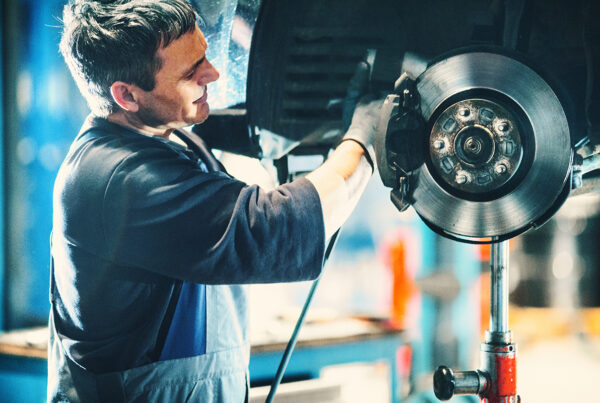
Brakes get asked to do more: higher speeds, more weight, and long grades where you ride them instead of stopping once at a light. Pad thickness, rotor condition, and brake fluid are not driveway items, but the symptoms are. A pull to one side, a pulse in the pedal, a pedal sitting lower than it used to, or a new grinding noise all belong in front of a technician before a trip, not after.
Cooling system, hoses, and belts are the classic hour-three failures. The Car Care Council advises checking coolant level frequently and changing it per your owner’s manual to prevent serious damage or engine failure, and warns that hoses and belts crack, go brittle, fray, or come loose, taking the cooling system, air conditioning, and power steering with them when they do.
Wipers and lights get the least attention and matter most in the rain. Blades want replacing about every six months, and the washer solvent topped off. Then walk around the car with somebody in the driver’s seat: headlights on both beams, brake lights, turn signals, and trailer lights if you are towing to the tailgate.
The Driveway List Versus the Lift List
Here is the honest split, and it is the part most checklists blur. Alabama never makes you do any of this, so the call is yours. Plenty of it you can do yourself with a tire gauge and a flashlight.
In the driveway, the night before:
- Cold pressure on all four tires to the door jamb spec, plus the spare.
- Tread depth with a penny or the wear bars, on every tire.
- The DOT date code on each sidewall, spare included.
- Visible fluid levels: engine oil, coolant, brake fluid, washer solvent.
- Wiper blades, and a full walk-around light check.
- Spare, jack, and lug wrench present and usable.
- Whatever you keep for emergencies: water, flashlight, phone cable, jumper cables.
And what needs a lift and a trained set of eyes:
- Brake pad and rotor thickness, plus lines and hoses checked for seepage.
- Suspension and steering play, wheel bearings, anything loose that highway speed amplifies.
- A cooling system pressure test, which finds the leak that only shows up hot.
- Belt and hose condition where they actually live, not just what shows from above.
- Undercar leaks and exhaust condition.
- Battery load testing, since a battery that starts fine at home can still quit on a cold morning in a parking deck.
- Tire wear patterns and alignment, which is how you learn a tire problem is really a suspension problem.
That second list is what a vehicle inspection before a long drive in Alabama actually buys you: the items nobody can judge by looking at them. It is also why people go looking for auto repair in Opelika, AL the week before a trip instead of the morning of.
How Far Ahead Should You Book a Pre-Trip Inspection in Opelika?
This is the part most people miss. An inspection can find something, which is the point of it, but finding it only helps if there is time left to fix it. Sometimes that means a part has to arrive. A specific tire size, a belt, a hose, a brake component: routine when the calendar has room, impossible when it does not. The same discovery is a non-event two weeks out and a cancelled trip on Friday afternoon.
So, practically, for a road trip car check in Opelika:
- Two weeks ahead for a normal long drive. Room to inspect, order, and install without rushing.
- Three weeks or more before a holiday or a big game weekend. Everybody in Lee County has the same idea at once, and parts distributors keep their own holiday calendars.
- Not the day before. We will always look, and we would rather see you late than never, but by then your options narrow to what is on the shelf.
We are deliberately not putting numbers in this post. Parts and labor pricing moves too fast for an article to stay honest, and a stale figure is worse than none. If you want to know what something takes before you commit, ask us for a current number through our Get a Quote page and we will price it for your vehicle.
Come See Us Before You Get on the Interstate
Auburn game weekends, the run up to Atlanta, Thanksgiving on the Gulf: those sit on the calendar months ahead, so the car has no excuse for being a surprise. Spend ten minutes in the driveway on what you can see, and let us take the rest.
Glover Tire Service has looked after Opelika, Auburn, and the rest of Lee County since 1968, and a pre-trip check is one of the easier things we do. We are at 1011 2nd Avenue in Opelika, minutes off the interstate, and you can reach us at (334) 749-0607. Schedule an appointment with enough lead time for us to order anything we find, then go enjoy the trip instead of thinking about the car.