If you moved to Opelika from Virginia or Pennsylvania, you spent years with a sticker on your windshield telling you when a shop had to look your car over. Then you got here, and nothing. No line at an inspection station, no annual pass or fail, no reminder in the mail.
That is not an oversight. Alabama simply does not have that requirement, and plenty of drivers here have never had one in their lives. Which leaves an honest question nobody answers for you: if the state never makes you, when should you actually get your car checked?
We have been answering that one at our counter on Second Avenue in Opelika since 1968. Here is the version we would give you standing right here.
What Alabama Actually Requires Is Less Than You Think
Alabama has no periodic safety inspection. Your registration renews without anyone confirming your brakes work, your tires have tread, or your headlights aim anywhere useful.
Alabama also has no emissions testing. The Alabama Department of Revenue puts it about as plainly as a government agency can: Alabama law does not provide for emissions testing of motor vehicles. No tailpipe test, no plug-in test, and no waiver process either, since there is nothing to be waived from.
So when a Lee County driver goes looking for Alabama vehicle inspection rules and comes up empty, that is the correct result. The search is not broken. The requirement is not there.
There is one exception, and it is narrower than most people assume.
The One Car Inspection Alabama Does Require Checks a Number, Not a Car
Alabama requires a physical VIN inspection, but only when a vehicle is getting its first Alabama certificate of title. The state’s title rules limit it to first certificates of title: a new vehicle applying for its first title, a vehicle arriving with an out-of-state title, and other vehicles not currently titled in Alabama.
Notice what is missing from that list. Where a currently valid Alabama certificate of title is assigned to a new owner, the agent processing the title is not required to physically verify the VIN and description of the vehicle. Put plainly: if you buy a car from a neighbor here in Opelika and that car already carries an Alabama title, the whole thing can go through without a single person laying eyes on the vehicle.
And when the VIN inspection does happen, look at what it covers. Under the state’s VIN inspection rule, the inspector verifies the VIN, make, year, model, and color, then signs the form. That is the job. Nobody is under the hood, nobody pulls a wheel, and nobody drives it.
So the only car inspection Alabama puts in your path confirms that the number on the dash matches the number on a form. It is a fraud check, and a good one. It was never built to tell you whether the car is safe.
Say a family moves here from across the Georgia line with a Georgia-titled car. That car does get inspected, and the inspector does exactly what the rule says: VIN, make, year, model, color, signature. The transmission that has been shifting hard since spring never comes up.
So the state is not going to tell you when to bring the car in. Something else has to.
Use Triggers, Not Dates
Stop trying to remember a date. Hang your checkups on events you already notice. You will never forget that you bought a truck, or that you are driving to the beach next month, or that something started squealing at the first stop sign on Pepperell Parkway. Those moments are already in your head. Attach the check to them and it takes care of itself.
Six triggers cover almost everything.
Trigger 1: You Just Bought a Used Car
This is the big one, and it is where Alabama’s rules leave the most room.
Say you buy a ten-year-old truck from somebody in Lee County. The title is already an Alabama title, so it gets assigned over and that is the end of it. No inspection, no verification, nothing. The first qualified person to look at those brakes is whoever you choose to take it to.
A vehicle history report does not fill that hole. The Federal Trade Commission is direct about it: a vehicle history report is not a substitute for an independent vehicle inspection, and it is always a good idea to pay for an independent mechanic to conduct a mechanical inspection of a used car. A report tells you what got written down somewhere. It cannot tell you the rear brakes are nearly gone.
It also helps to know that the FTC’s Buyers Guide rule, the window sticker with the warranty boxes, applies to dealers. A private seller down the road is not covered by it at all.
Best case: get it looked at before money changes hands. Second best: get it looked at the week you buy it, so you learn what you actually bought while you can still plan around it.
Trigger 2: A Long Trip Is on the Calendar
Highway miles are a different kind of work than running to Tiger Town and back. Sustained speed, heat, a loaded vehicle, and hours between exits all stack up.
Breakdowns are common, and a lot of them are things a shop can see coming. AAA received over 27 million emergency roadside service calls across the United States in 2024. Roughly 13 million of those were tows, and about 7 million were battery related. Batteries in particular rarely quit without warning. They get weak first, and weak is measurable on a bench in a few minutes.
A pre-trip check covers tires and tire pressure, brakes, battery and charging, belts and hoses, coolant and fluids, lights and wipers, plus the AC if you are traveling in summer. It beats finding out on the shoulder of I-85 with everybody’s luggage in the back.
Give yourself a week or two of margin before you leave, in case a part has to be ordered.
Trigger 3: Something New Is Making Noise, or Smell, or Feel Wrong
Anything new is a trigger. Not necessarily an emergency, but a trigger.
A squeal that shows up at low speed. A grinding sound when you brake. A pull to one side, or a shudder in the steering wheel out on US 280. A vibration that was not there last month. A hot or sweet or burning smell. A warning light that comes on, even if it goes back off.
Cars are pretty good at giving notice. A brake pad that squeals is telling you something well before it becomes a rotor problem, which is also why the habits that make brakes last longer are worth knowing. The cheapest moment in the life of almost any repair is right when the symptom first shows up.
When you call, describe what it sounds like, when it happens, and whether braking or turning changes it. That shortens the diagnosis.
Trigger 4: You Are Already Buying Tires
This one is free, and almost everybody misses it.
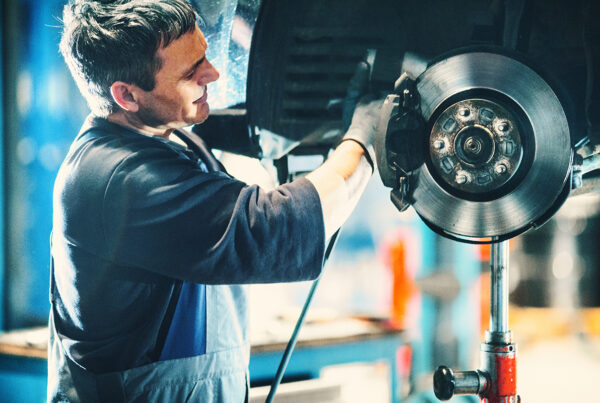
When your vehicle is up on the lift with the wheels off, half of what a shop would want to inspect is already in plain view. Brake pads and rotors. Suspension components and wheel bearings. Alignment problems readable right off the wear pattern on the tires you are replacing. If you are in for tires anyway, ask for a look at everything else.
Tires also come with intervals you can actually follow. The U.S. Tire Manufacturers Association recommends checking your tires at least once a month, when they are cold, meaning parked for three or more hours. Replace them when tread reaches 2/32nds of an inch, which you can check with a penny turned upside down in a groove: if the tread covers part of Lincoln’s head, you still have tread. Rotate every 5,000 to 8,000 miles if your owner’s manual does not say otherwise.
If a single tire is the problem rather than the whole set, knowing whether it can be repaired or has to be replaced is the first question to settle.
Trigger 5: The Season Turns in Opelika
Our weather hands you two checkpoints a year.
Opelika’s hot season runs about 3.9 months, from May 24 to September 21, with average daily highs above 82 degrees. July is the peak, averaging an 89 degree high. That is hard duty for a battery, a cooling system, and an AC compressor all at once. Getting the AC and cooling system checked in late April or early May, before the first genuinely hot week, is the move. If yours is already blowing warm air, that is its own trigger, and it will not fix itself.
The cool season runs from about November 30 to February 23, and January averages a 38 degree low. That swing is why your tire pressure light tends to show up on the first properly cold morning. Inflation pressure moves 1 to 2 PSI for every 10 degrees of temperature change, so a 40 degree drop overnight can pull real air out of all four tires with nothing actually wrong. Set them back to the number on the driver’s door label and carry on.
Two dates, then: before the heat, and at the first cold snap.
Trigger 6: Your Tag Month Comes Around
Alabama did give you one annual date, even if it never attached an inspection to it.
Registrations here renew on a staggered schedule from January through November, based on the first letter of the owner’s last name. If your last name starts with F, G, or N, for example, your renewal month is April, and the registration expires April 30. Leased, commercial, and fleet vehicles renew in October and November.
That is a date you cannot forget, because the state will not let you. So borrow it. Tag month becomes checkup month. Once a year, when you go handle the tag, book the car in for a general look-over. It is the closest thing to an annual inspection Alabama has, and remembering it costs you nothing, because you were already remembering it.
For local businesses running vans or trucks around Opelika and Auburn, this is even tidier. Fleet tags come due in October and November, which makes a clean annual service window for the whole fleet instead of chasing vehicles one at a time.
Putting the Triggers on One Page
The whole system, arranged by event:
- Bought a used car? Get it inspected, ideally before you pay, at the latest the same week.
- Long trip coming? Full pre-trip check, a week or two out.
- New noise, smell, pull, or shudder? Come in while it is still just a symptom.
- Buying tires? Ask for brakes, suspension, and alignment while it is on the lift.
- Season turning? AC and cooling before the heat; tire pressure at the first cold morning.
- Tag month? General look-over, once a year, on a date you already know.
And the habit underneath all of it: check your tire pressure monthly.
What a Real Check Looks Like at an Auto Repair Shop in Opelika AL
Since Alabama never defined one, here is what we mean by a general look-over, so you know what you are asking for when you call around for auto repair in Opelika AL.
Tires and pressure, including tread depth and wear pattern. Brakes front and rear. Battery and charging system. Belts, hoses, and the cooling system. Fluid levels and condition. Steering and suspension. Lights, wipers, and whatever the dash is trying to tell you.
It is the same list a safety inspection would have covered in a state that has one, minus the line and the deadline.
Getting a Current Number Before You Book
We are not going to print prices on a blog post. Parts availability moves, and what your vehicle needs moves with it. What we will do is give you a straight answer when you ask. Request a current quote and we will tell you what the work involves and what it comes to for your vehicle, before we start anything.
The Short Version
Alabama does not require a safety inspection or an emissions test. The one VIN inspection in the system only applies when a vehicle is first titled here, and all it confirms is a number on a form. Nobody is going to tell you when to get your car checked.
So use triggers instead of dates. Buy a car, take a trip, hear a noise, buy tires, feel the season turn, renew your tag. Those six events already live in your calendar, and between them they cover nearly everything a yearly inspection would have caught.
If one of those just happened to you, this is a good week for it. We handle tires, brakes, oil changes, AC and general auto repair for Opelika and Lee County drivers. Schedule an appointment and we will take a look.